Whiteplains Plantation SC is a premier residential aviation community. Located 20 minutes W of Columbia, Whiteplains Plantation combines a quiet rural location, friendly neighbors, and access to some of the state’s best schools. There are currently 50+ aircraft based at the airpark. Pattern Altitude 1500' Right traffic 9 - ELV 524' Left traffic 27 - ELV 491' Rwy 3000' X 35' paved Columbia CAE approach FR N 133.4 FR S 124.15 CTAF 122.9 Lighted Dusk to 11:00 pm 5 clicks
Whiteplains Logo
Saturday, May 26, 2012
5/26/2012
Thanks to Steve Sanderson for sending us pictures from this mornings clean up of Windy Road and to all of the people that showed up. A special thanks to the Fastnaught's for hosting the breakfast.
It was reported that twenty plus bags of trash was collected along Windy Road. Trash bag count for Whiteplains was again, zero.
Thanks to Steve Sanderson for sending us pictures from this mornings clean up of Windy Road and to all of the people that showed up. A special thanks to the Fastnaught's for hosting the breakfast.
It was reported that twenty plus bags of trash was collected along Windy Road. Trash bag count for Whiteplains was again, zero.
Monday, May 21, 2012
AERObridge is an aviation organization of pilots and supporting ground personnel active in
disasters. We work with both governmental and non-governmental agencies. We have
participated in relief efforts in Haiti, Japan and in the US. Our most recent work was after the
tornado disaster in Tuscaloosa, Alabama in 2011. On Tuesday, June 5th, AERObridge will
coordinate General Aviation and Business Aviation Aircraft from North Carolina, South Carolina
and Georgia in support of the 2012 South Carolina State Hurricane Full Scale Exercise (FSE).
We will base or operations at the Bamberg County Airport (99N) located at Bamberg, South
Carolina.
We could use your help.
AERObridge has been assigned the following missions:
1. Aerial reconnaissance to enable on-site evaluation of emergency situations. AERObridge will
be responsible for providing aerial surveillance of hurricane evacuation routes through Bamberg
County--providing real-time information (voice and video) to decision makers.
2. Establish an Incident Management Team at Bamberg County Airport.
AERObridge will establish an IMT reporting to Bamberg County Emergency Management
Services. This team will be responsible for the coordination of arriving aircraft and movement in
the ramp and aircraft parking areas.
3. Airlift of equipment and supplies in support of disaster relief operations.
General aviation pilots based in Georgia, South Carolina and North Carolina will fly into Bamberg
County Airport (99N) carrying basic relief supplies with jet aircraft landing at the larger Orangeburg
Airport (OGB).
Although this is just an exercise we’re asking GA pilots and companies with business aircraft to
participate in this exercise to demonstrate the strength and value of GA in emergencies.
Companies or individuals wishing to register their aircraft for the June 5th exercise may do so at
http://www.aerobridge.org by clicking on the “join us” tab and then on the tab for “register your
aircraft”. If you don’t have an aircraft and/or wish to work with support functions such as aircraft
marshaling, aircrew services, administration, operations, plans or logistical support, enter the word
“Support” under aircraft make and we will contact you.
We appreciate all that the members of the Whiteplains Pilots’ Association do for aviation and
thank you for your support!
Greg Stidom
Field Director of Emergency Services
North and South Carolina
Runway reseal
We are moving forward on the runway sealcoating/repainting project. The runway will need to be closed for 2-3 days depending on weather. We have requested the work be done Monday - Wednesday as these are days we typically see the least flying activity. The dates we have proposed to the contractor are:
June 18 - 20, 2012 or June 25 - 27, 2012
The first activity you will notice is the contractor cleaning and filling all cracks on the runway. Following that the sealcoat will be applied and allowed to dry for at least 24 hours before the runway numbers and markings are repainted. This process is much the same as we did two years ago on the roadways and taxiways.
Your help and cooperation with this will be appreciated. If you have any concerns, or conflicts with these dates, please let me know immediately.
Jeff
803-730-8090
Saturday, May 19, 2012
Gilbert Fire Department BBQ
Thanks to all of our Whiteplains neighbors
who joined us this noon for the Gilbert
Fire Department BBQ.
Special thanks to Denise Perry
and Laurie Ackermanwho delivered our feast,
and to those who were not able to attend but
stillmade a donation.
We live in a GREAT neighborhood!Write up and Photo's by Steve Sanderson
Tuesday, May 15, 2012
The May 20th Breakfast Club has been moved from Green Sea to Aiken. Please spread this change to all members.
http://www.airnav.com/airport/KAIK
Wednesday, May 09, 2012
2012 Whiteplains Mowing Schedule
(Whiteplains Plantation Announcement)
2012
WHITEPLAINS
MOWING SCHEDULE
NOTES: The SCAG mower is easier to control (less likely to hit runway lights) if not run at max speed. The
throttle must be full open to get the blade speed up, but limit your
forward speed if at all possible. The key is prone to falling out, we
have lost one already this season.
Summer Mowers
April
1. Willem Meiners
2. Bo Fender
May
1. Clem Spencer
2. Rob Bridgers
June
1. Ed Fisher
2. Bob Gillmann
July
1. Jeff Cargile
2. Mike Knox
August
1. Mike Moore
2. Dennis Perry
September
1. Steve Crimm
2. Phil Rainwater
October
1. Jim Franklin
2. Ray Ackerman
Report any Problems to:
Jeff Cargile – Service Mower
Jim Wheat – Weed Control/Fuel/Parts, etc.
Dennis Perry – Service Mower
New FAA Safety Briefing Available
Notice Number: NOTC3742
The May/June 2012 issue of FAA Safety Briefing focuses on
extreme weather. Articles provide important tips on how to detect,
prepare for, and avoid some of the more extreme varieties of weather
conditions GA pilots may encounter in their region of the country,
including thunderstorms, tornadoes, hurricanes, icing, fog, freezing
rain and more. Hear from weather experts at the FAA who offer advice on
how to be prepared for these situations and provide updates on the many
helpful tools and resources now available to pilots.
For more on how to improve your weather knowledge, check out the new issue at: http://1.usa.gov/IHfCA6.
In addition, the issue's Nuts, Bolts, and Electrons department (pg.
27) looks at the newly released versions of the Aviation Maintenance
Technician (AMT) Handbooks, and Vertically Speaking (pg. 29) reviews
minimum safe altitudes and VFR weather minimum for rotorcraft
operations.
This notice is being sent to you because you selected "FAA Newsletters"
in your preferences on FAASafety.gov.
If you wish to adjust your selections, log into
https://www.faasafety.gov/Users/pub/preferences.aspx where you can
update your preferences.
Over 10,150 AMTs earned an AMT Award last year. Will you, this year?
Tuesday, May 08, 2012
Whiteplains SCBC 2012
Photoshow of last Sunday's SCBC held right here at Whiteplains Plantation.
What a great turnout for the SC Breakfast Club this morning. Thanks to everyone that worked so hard to make this event a tremendous success. Special thanks to Mike and Shelly Knox for hosting. I have heard many people say this was the best breakfast club we have ever had at Whiteplains.
It was a true testament to the community spirit that we came together in such a fine way. We have often said Whiteplains is the premier fly-in community, this Sunday we showed the aviation community this it absolutely true.
Thank you,
Jeff
Sunday, April 29, 2012
Food Scapes News
Thought I would let you know that Food Scapes at Lake City Municipal Airstrip 51J last day open was today. They may have another buyer, but the lady Kathy is closing. Her husband will continue to manage the airstrip. I thought I would let you know in case you want to blog it. I know others in the neighborhood fly there occasionally.
Reported by: Michael Benton
4-29-2012
Reported by: Michael Benton
4-29-2012
Wednesday, April 25, 2012
Phase One Key Pad Pedestal Damage
(Whiteplains Plantation Announcement.) __ Sometime yesterday a vehicle hit the brick keypad pedestal at the Phase I entrance and caused quite a bit of damage. It appears the pedestal was hit while someone was exiting the neighborhood. As of today we do not know who the responsible party is. If anyone knows anything about this, please contact me with the details. Jeff 730-8090
Tuesday, April 24, 2012
787 Features & Differences
(From a UAL Pilot)
I just completed the first pilot training class on the 787 at United Airlines, an airplane which is destined to replace the 767 and live for many years after I retire. Here's what I've learned in 787 training so far. By the way, last night we passed our MV (maneuvers validation) check ride, with emergency after emergency, and the FAA observing. Tonight was our LOE (line-oriented evaluation), again with FAA - this time 2 FAA observers. It's 0200 and I just got back to the hotel and poured a well-earned glass of wine to celebrate. I now have a type rating in the 787. Phew. I'm pretty confident this will be the last one for me.
I've summarized some of the major differences and unique features of the 787 versus more traditional "old school" airplanes like the 777 (not kidding) - from the pilot's viewpoint. Our "Differences" course takes 11 days to gain an FAA type rating, which is a "common" type rating with the 777. The course has been like drinking from a fire hose, but has finally come together. Some of our pilots attended Boeing's 5-day differences course, and deemed it unacceptable. The FAA approved the Boeing 5-day course, but our guys decided it lacked too much information. FAA is observing our checkrides now, and taking our course as well, to certify the training. We're just the guinea pigs.
A computer nerd would describe the 787 as 17 computer servers packaged in a kevlar frame. The central brains is the Common Core System (CCS). Two Common Computing Resources (CCRs) coordinate the communications of all the computer systems, isolating faults and covering failed systems with working systems. When battery power is first applied to the airplane in the morning, it takes about 50 seconds for the L CCR to boot up. After this, a few displays light up and you can start the APU. If there is a major loss of cockpit displays, this may require a CCR reboot, which would take about a minute. Here are a few of the major features and differences from the 777.
Electrics - Though a smaller plane, the 787 has 4 times the electric generating power of the 777 - 1.4 gigawatts. Generators produce 235 VAC for the big power users. Other systems use the traditional 115 VAC and 28 VDC. There are 17 scattered Remote Power Distribution Units which power about 900 loads throughout the plane. The big power distribution system is in the aft belly, along with a Power Electronics Cooling System (PECS). This is a liquid cooling system for the large motor power distribution system. There's also an Integrated Cooling System (ICS), which provides refrigerated air for the galley carts and cabin air, and a Miscellaneous Equipment Cooling System for Inflight Entertainment Equipment.
If 3 of the 4 engine generators fail, the APU starts itself. The APU drives two generators, and can be operated up to the airplane's max altitude of 43,000 feet. If you lose all 4 engine generators, the RAT (ram air turbine) drops out (like a windmill), powering essential buses. (It also provides hydraulic power to flight controls if needed).
If you lose all 4 engine generators and the two APU generators (a really bad day), you are down to Standby Power. The RAT will drop out and provide power, but even if it fails, you still have the autopilot and captain's flight director and instruments, FMC, 2 IRSs, VHF radios, etc. If you're down to batteries only, with no RAT, you'd better get it on the ground, as battery time is limited. Brakes and antiskid are electric - 28V - so you don't lose brakes or antiskid even when you're down to just standby power.
Normal flight controls are hydraulic with a couple exceptions. Engine driven and electric hydraulic pumps operate at 5000 psi (versus normal 3000 psi) to allow for smaller tubing sizes and actuators, thus saving weight. If you lose all 3 hydraulic systems (another bad day), you still have two spoiler panels on each wing which are electrically powered all the time, as is the stabilizer trim. You can still fly the airplane (no flaps, though). If you're having an even worse day and you lose all hydraulics and all generators, flight control power is still coming from separate Permanent Magnet Generators (PMGs) which produce power even if both engines quit and are windmilling. If the PMGs fail, too, your flight controls will be powered by the 28 V standby bus.
If you lose all 3 pitot/static systems or air data computers, the airplane reverts to angle of attack speed (converts AOA to IAS), and this is displayed on the normal PFDs (primary flight displays) airspeed indicator tapes. GPS altitude is substituted for air data altitude and displayed on the PFD altimeter tapes. Very convenient.
If you lose both Attitude and Heading Reference Units (AHRUs), it reverts to the standby instrument built-in attitude & heading gyro, but displays this on both pilot's PFDs for convenience.
If you lose both Inertial Reference Units, it will substitute GPS position, and nothing is lost.
If someone turns one or both IRSs off in flight (I hate it when they do that), you can realign them - as long as one of the GPSs is working!
There is no pneumatic system. The only engine bleed is used for that engine's anti-ice. Wing anti-ice is electric. Each of two air conditioning packs control two CACs, which are electric cabin air compressors. The four CACs share two air inlets on the belly. Each pack controller controls two CACs, but if a pack controller fails, the remaining pack controller takes over control of all 4 CACs.
There are no circuit breakers in the cockpit. To check on them, or if you get a message that one has opened (more likely), you select the CBIC (circuit breaker indication and control) display on one of the MFDs (multi function displays). There you can reset the virtual C/B if it is an "electronic" circuit breaker. You can't reset a popped "thermal" circuit breaker.
If you have an APU fire on the ground or inflight, the fire extinguishing bottle is automatically discharged. If there is a cargo fire, the first two of seven bottles will automatically discharge also.
There's a Nitrogen Generation System which provides automatic full-time flammability protection by displacing fuel vapors in the fuel tanks with nitrogen (Remember TWA 800?).
Like the 767 and 777, the 787 also has full CPDLC capability (controller-to-pilot datalink communications). In addition, its full FANS capability includes ADS-B in & out. The controller can uplink speed, heading, and altitude changes to the airplane. These show up on a second line right under the speed, heading and altitude displays on the mode control panel. If you pilot wants to use them, he can press a XFR button next to each window. The controller can even uplink a conditional clearance, like - After passing point XYZ, climb to FL390. If you accept this, it will do it automatically.
Fuel system - like the 777, the 787 has a fuel dump system which automatically dumps down to your maximum landing weight, if that is what you want. In addition, it has a Fuel Balance switch which automatically balances your L & R main tanks for you. No more opening crossfeed valves and turning off fuel pumps in flight. No more forgetting to turn them back on, either.
Flight Controls - An "Autodrag" function operates when the airplane is high on approach and landing flaps have been selected. It extends the ailerons and two most outboard spoilers, while maintaining airspeed, to assist in glidepath capture from above, if you are high on the glideslope. The feature removes itself below 500 feet.
Cruise flaps is an automated function when level at cruise. It symmetrically moves the flaps, ailerons, flaperons, and spoilers based on weight, airspeed and altitude to optimize cruise performance by varying the wing camber, thus reducing drag.
Gust suppression - Vertical gust suppression enhances ride quality when in vertical gusts and turbulence. It uses symmetric deflection of flaperons and elevators to smooth the bumps. This should result in fewer whitecaps in passengers' coffee and cocktails. Lateral gust suppression improves the ride when on approach by making yaw commands in response to lateral gusts and turbulence.
Instrument Approaches - The airplane is actually approved for autoland based not only on ILS but on GLS approaches - GPS with Ground based augmentation system, which corrects the GPS signals. GLS minimums are the same as CAT I ILSs - 200' and 1/2 mile visibility. Our airline is not yet approved for GLS autolandings yet, though we will be doing GLS approaches.
Special Cat I & II HUD approaches - These allow lower than normal minimums when the Heads Up Devices are used at certain approved airports (HUDs). The HUDs include runway centerline guidance which helps you stay on the centerline on takeoff when visibility is greatly reduced. It uses either ILS or GLS for this.
Cabin - Pressurization differential pressure maximum is 9.4 psid, so the cabin altitude is only 6000 feet when at the max cruising altitude of 43,000 feet. There is a cockpit humidifier switch, and cabin air humidification is fully automatic. Cabin windows are larger than other airplanes, and window shading is electronic. The passenger can select 5 levels of shading, from clear to black. The flight attendants can control the cabin lighting temperature - mood lighting - to aid in dealing with changing time zones (evening light after dinner, morning light to wake up, etc.).
Much of the cockpit seems like it was designed by Apple. The Control Display Units (CDUs) are virtual, so you can move them from one MFD to another. In fact, you can configure the displays in 48 different ways, I think, though we have found a few favorites we will use to keep it simple. To move the cursor from one MFD to another, you can either use a button, or you can "flick" your finger across the trackpad (Cursor Control Device) to fling the cursor from one screen to the next - much like an iPad.
I'm going home this morning, and will return for a 777 simulator ride before I go back to work. They want to make sure we've still got the old-fashioned legacy airplane in our brain before we fly the 777 again, even though it shares a "common type rating". We won't get the first 787 until October, and begin operations in November or December. At that time I'll return for at least 4 days refresher training before beginning IOE - initial operating experience in the airplane - with passengers.
What a ride. It may be "fuel efficient", but I'm glad someone else is paying for the gas.
I just completed the first pilot training class on the 787 at United Airlines, an airplane which is destined to replace the 767 and live for many years after I retire. Here's what I've learned in 787 training so far. By the way, last night we passed our MV (maneuvers validation) check ride, with emergency after emergency, and the FAA observing. Tonight was our LOE (line-oriented evaluation), again with FAA - this time 2 FAA observers. It's 0200 and I just got back to the hotel and poured a well-earned glass of wine to celebrate. I now have a type rating in the 787. Phew. I'm pretty confident this will be the last one for me.
I've summarized some of the major differences and unique features of the 787 versus more traditional "old school" airplanes like the 777 (not kidding) - from the pilot's viewpoint. Our "Differences" course takes 11 days to gain an FAA type rating, which is a "common" type rating with the 777. The course has been like drinking from a fire hose, but has finally come together. Some of our pilots attended Boeing's 5-day differences course, and deemed it unacceptable. The FAA approved the Boeing 5-day course, but our guys decided it lacked too much information. FAA is observing our checkrides now, and taking our course as well, to certify the training. We're just the guinea pigs.
A computer nerd would describe the 787 as 17 computer servers packaged in a kevlar frame. The central brains is the Common Core System (CCS). Two Common Computing Resources (CCRs) coordinate the communications of all the computer systems, isolating faults and covering failed systems with working systems. When battery power is first applied to the airplane in the morning, it takes about 50 seconds for the L CCR to boot up. After this, a few displays light up and you can start the APU. If there is a major loss of cockpit displays, this may require a CCR reboot, which would take about a minute. Here are a few of the major features and differences from the 777.
Electrics - Though a smaller plane, the 787 has 4 times the electric generating power of the 777 - 1.4 gigawatts. Generators produce 235 VAC for the big power users. Other systems use the traditional 115 VAC and 28 VDC. There are 17 scattered Remote Power Distribution Units which power about 900 loads throughout the plane. The big power distribution system is in the aft belly, along with a Power Electronics Cooling System (PECS). This is a liquid cooling system for the large motor power distribution system. There's also an Integrated Cooling System (ICS), which provides refrigerated air for the galley carts and cabin air, and a Miscellaneous Equipment Cooling System for Inflight Entertainment Equipment.
If 3 of the 4 engine generators fail, the APU starts itself. The APU drives two generators, and can be operated up to the airplane's max altitude of 43,000 feet. If you lose all 4 engine generators, the RAT (ram air turbine) drops out (like a windmill), powering essential buses. (It also provides hydraulic power to flight controls if needed).
If you lose all 4 engine generators and the two APU generators (a really bad day), you are down to Standby Power. The RAT will drop out and provide power, but even if it fails, you still have the autopilot and captain's flight director and instruments, FMC, 2 IRSs, VHF radios, etc. If you're down to batteries only, with no RAT, you'd better get it on the ground, as battery time is limited. Brakes and antiskid are electric - 28V - so you don't lose brakes or antiskid even when you're down to just standby power.
Normal flight controls are hydraulic with a couple exceptions. Engine driven and electric hydraulic pumps operate at 5000 psi (versus normal 3000 psi) to allow for smaller tubing sizes and actuators, thus saving weight. If you lose all 3 hydraulic systems (another bad day), you still have two spoiler panels on each wing which are electrically powered all the time, as is the stabilizer trim. You can still fly the airplane (no flaps, though). If you're having an even worse day and you lose all hydraulics and all generators, flight control power is still coming from separate Permanent Magnet Generators (PMGs) which produce power even if both engines quit and are windmilling. If the PMGs fail, too, your flight controls will be powered by the 28 V standby bus.
If you lose all 3 pitot/static systems or air data computers, the airplane reverts to angle of attack speed (converts AOA to IAS), and this is displayed on the normal PFDs (primary flight displays) airspeed indicator tapes. GPS altitude is substituted for air data altitude and displayed on the PFD altimeter tapes. Very convenient.
If you lose both Attitude and Heading Reference Units (AHRUs), it reverts to the standby instrument built-in attitude & heading gyro, but displays this on both pilot's PFDs for convenience.
If you lose both Inertial Reference Units, it will substitute GPS position, and nothing is lost.
If someone turns one or both IRSs off in flight (I hate it when they do that), you can realign them - as long as one of the GPSs is working!
There is no pneumatic system. The only engine bleed is used for that engine's anti-ice. Wing anti-ice is electric. Each of two air conditioning packs control two CACs, which are electric cabin air compressors. The four CACs share two air inlets on the belly. Each pack controller controls two CACs, but if a pack controller fails, the remaining pack controller takes over control of all 4 CACs.
There are no circuit breakers in the cockpit. To check on them, or if you get a message that one has opened (more likely), you select the CBIC (circuit breaker indication and control) display on one of the MFDs (multi function displays). There you can reset the virtual C/B if it is an "electronic" circuit breaker. You can't reset a popped "thermal" circuit breaker.
If you have an APU fire on the ground or inflight, the fire extinguishing bottle is automatically discharged. If there is a cargo fire, the first two of seven bottles will automatically discharge also.
There's a Nitrogen Generation System which provides automatic full-time flammability protection by displacing fuel vapors in the fuel tanks with nitrogen (Remember TWA 800?).
Like the 767 and 777, the 787 also has full CPDLC capability (controller-to-pilot datalink communications). In addition, its full FANS capability includes ADS-B in & out. The controller can uplink speed, heading, and altitude changes to the airplane. These show up on a second line right under the speed, heading and altitude displays on the mode control panel. If you pilot wants to use them, he can press a XFR button next to each window. The controller can even uplink a conditional clearance, like - After passing point XYZ, climb to FL390. If you accept this, it will do it automatically.
Fuel system - like the 777, the 787 has a fuel dump system which automatically dumps down to your maximum landing weight, if that is what you want. In addition, it has a Fuel Balance switch which automatically balances your L & R main tanks for you. No more opening crossfeed valves and turning off fuel pumps in flight. No more forgetting to turn them back on, either.
Flight Controls - An "Autodrag" function operates when the airplane is high on approach and landing flaps have been selected. It extends the ailerons and two most outboard spoilers, while maintaining airspeed, to assist in glidepath capture from above, if you are high on the glideslope. The feature removes itself below 500 feet.
Cruise flaps is an automated function when level at cruise. It symmetrically moves the flaps, ailerons, flaperons, and spoilers based on weight, airspeed and altitude to optimize cruise performance by varying the wing camber, thus reducing drag.
Gust suppression - Vertical gust suppression enhances ride quality when in vertical gusts and turbulence. It uses symmetric deflection of flaperons and elevators to smooth the bumps. This should result in fewer whitecaps in passengers' coffee and cocktails. Lateral gust suppression improves the ride when on approach by making yaw commands in response to lateral gusts and turbulence.
Instrument Approaches - The airplane is actually approved for autoland based not only on ILS but on GLS approaches - GPS with Ground based augmentation system, which corrects the GPS signals. GLS minimums are the same as CAT I ILSs - 200' and 1/2 mile visibility. Our airline is not yet approved for GLS autolandings yet, though we will be doing GLS approaches.
Special Cat I & II HUD approaches - These allow lower than normal minimums when the Heads Up Devices are used at certain approved airports (HUDs). The HUDs include runway centerline guidance which helps you stay on the centerline on takeoff when visibility is greatly reduced. It uses either ILS or GLS for this.
Cabin - Pressurization differential pressure maximum is 9.4 psid, so the cabin altitude is only 6000 feet when at the max cruising altitude of 43,000 feet. There is a cockpit humidifier switch, and cabin air humidification is fully automatic. Cabin windows are larger than other airplanes, and window shading is electronic. The passenger can select 5 levels of shading, from clear to black. The flight attendants can control the cabin lighting temperature - mood lighting - to aid in dealing with changing time zones (evening light after dinner, morning light to wake up, etc.).
Much of the cockpit seems like it was designed by Apple. The Control Display Units (CDUs) are virtual, so you can move them from one MFD to another. In fact, you can configure the displays in 48 different ways, I think, though we have found a few favorites we will use to keep it simple. To move the cursor from one MFD to another, you can either use a button, or you can "flick" your finger across the trackpad (Cursor Control Device) to fling the cursor from one screen to the next - much like an iPad.
I'm going home this morning, and will return for a 777 simulator ride before I go back to work. They want to make sure we've still got the old-fashioned legacy airplane in our brain before we fly the 777 again, even though it shares a "common type rating". We won't get the first 787 until October, and begin operations in November or December. At that time I'll return for at least 4 days refresher training before beginning IOE - initial operating experience in the airplane - with passengers.
What a ride. It may be "fuel efficient", but I'm glad someone else is paying for the gas.
Friday, April 20, 2012
Archaeopteryx: Fussstart (Foot launch)
Tuesday, April 17, 2012
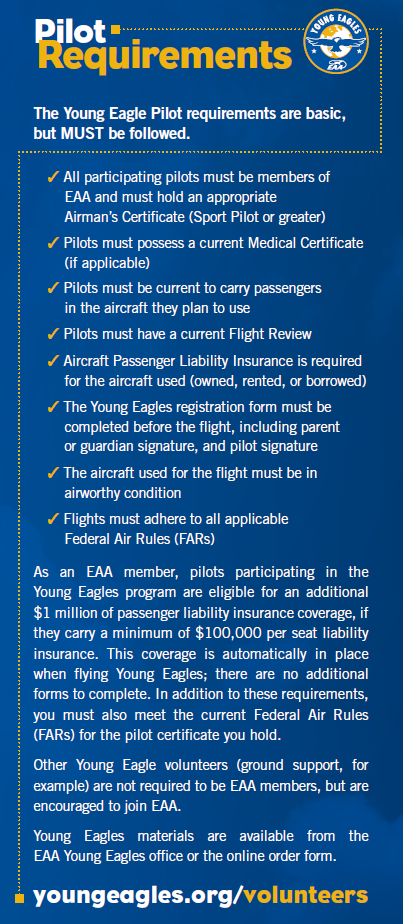
Pilots Requirements for Flying Young Eagles
This is a list of Pilot Requirements for flying Young Eagles that is put out by the EAA. Please be sure you meet all requirements before flying Young Eagles at Whiteplains.
Thanks for you past support, to pilots and ground crew. With out your help, we wouldn't have a Young Eagles event at Whiteplains. Also thanks to the Board of Directors that support the YE program.
Don Cook
Whiteplains YE Flight Leader
Click to see full size
Thanks for you past support, to pilots and ground crew. With out your help, we wouldn't have a Young Eagles event at Whiteplains. Also thanks to the Board of Directors that support the YE program.
Don Cook
Whiteplains YE Flight Leader
Click to see full size
Sunday, April 15, 2012
Wednesday, March 21, 2012
Mooney Scooter Chair Tug Project Up-date
Short slide show on current state of the tug. Special thanks to Ed Fisher for doing the hard work, all the cutting and welding.
Monday, March 19, 2012
Get together at Jim Wheat's Hangar 3-13-2012
Slide show by: Don Cook
Jim Wheat invited Whiteplains to a cook-out at his hangar Sunday. Fun was had by
Sunday, March 18, 2012
Cody Celebration 3-17-2012
Video by: Don Cook
In case you didn't get to join us last night to welcome home Cody, here is a short video. After a few days at Whiteplains, Cody goes with Steve to Florida, for Sun-N-Fun before heading back to the University of Illinois.
Subscribe to:
Posts (Atom)